Bill..
Thanks for your time and research in your posts in this section of TPR:
I would like to post a couple of comments which are of the $.02 varieties of opinions only....


James Quinn stressed the importance of final times juxtaposed with the early pace time as a truer measure of a horse's performance. Quinn mentioned about the simple compound of EPR with LPR; that the authors of Pace Makes the Race used effectively to attack the races.

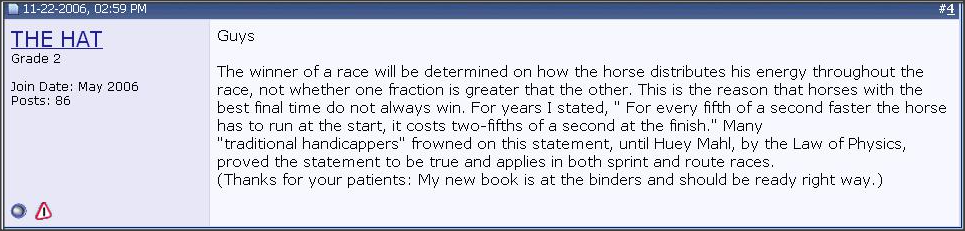
In another book with a similar title but titled "The Race is Pace" written by Huey Mahl. One of the most important aspect of Mahl's short book is his premise that "the early pace has a telescopic effect on the rest of the race."
This simple sentence is brief yet powerful in presenting Huey Mahl's theory that how fast the early pace is run will affect the late pace "exponentially."
EPR + LPR = TPR is an effective tool but it is a linear equation that does not give enough importance to the impact of the early pace that Mahl so eloquently writes; yet in one simple sentence.
Speed figures are only accurate if they followed Mahl's premise in his short book. Now I am no expert whatsoever in the "realm of speed figure performances" but I am adamant that speed figures are only valid if they followed Mahl's premise and they used early pace performances to determine speed figures for the final times of the teletimers. This is why Beyer's speed figures are just as valid as the DRF daily variants plus the 3 year old track records that Doc Sartin mentioned in some publication of the Follow-Ups.
But to keep things simple and to keep with the spirit of Huey Mahl and Jim Bradshaw; and to cohere to the topic of this thread presented by you, Bill;
Let's remember what Jim Bradshaw wrote: