I wanted the review the result chart of the winner, Toledo Eddie

Here is the result chart of the "blistering race" won by Toledo Eddie who romped by double digit lengths. Some might ask where did this "huge effort" come from this 7 year-old gelding... But the "real question" is did it really improved that much or did it just run the same race;but it just re-distributed its energy differently as Jim Bradshaw postulated......??

Here is the past performance again. Let's focus on the pace fractions of the last paceline: 22.2 and 45.2 and 110.1 with a final time of 135.2 ( all in fifths)

But let's look at a more detailed result chart of that paceline from that race:
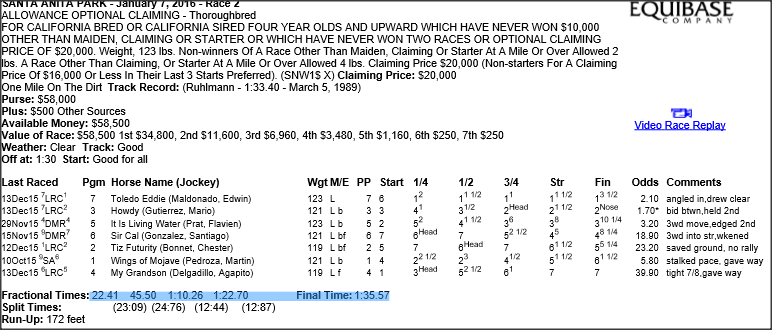
When we look at the detailed Equibase chart with pace fractions in tenths; we have the pace fractions of the last paceline of Toledo Eddie rounded to the nearest fifths as 22.2 for 2F and 45.2 for 4F and 110.1 for 6 F and a final time rounded to 135.3 not the 135.2 listed in the past performances.
Bradshaw stated that for every fifth of a second used in the early pace; it will the affect the finish by two-fifths. Let's put it more straight forward.
One fifth in EARLY Pace affects FINAL time by Two-fifths...energy used up or energy saved in the early pace.
If used up or if the horse has to run a "Fifth" of a second faster it will lose "Two-fifths" at the final time.
If energy is saved in the Early Pace; then the horse will gain "Two-fifths" at the final time.
Toledo Eddie hit the mile marker in today's result chart in 134 and 4 fifths. Did it "freaked" out or did it run the same race but it just redistributed its energy differently as Bradshaw stated?????
In today's match-up, it ran two furlongs in 22 and 4 fifths...so it conserved two-fifths of energy compared to the 22 and two-fifths that it ran in its last paceline so it will gain 4 fifths at the final time...Did Toledo Eddie gained four-fifths of energy today???
Last paceline
22.2 45.2 110.1 and a final time of 135.3
today's result chart:
22.4 45.2 109.3 and a final time of 134.4 which means that it gained four-fifths in the final time because it conserved two-fifths in the early pace; just exactly as Jim Bradshaw stated in his 25 words statement.
This is just one example; I am positive that we can find many other examples of today's comparison....