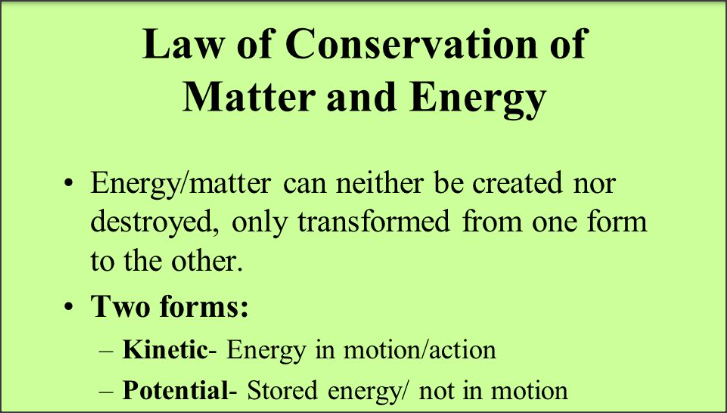
The conservation of energy is a fundamental concept of physics along with the conservation of mass and the conservation of momentum. Within some problem domain, the amount of energy remains constant and energy is neither created nor destroyed. Energy can be converted from one form to another (potential energy can be converted to kinetic energy) but the total energy within the domain remains fixed.
In Physics:
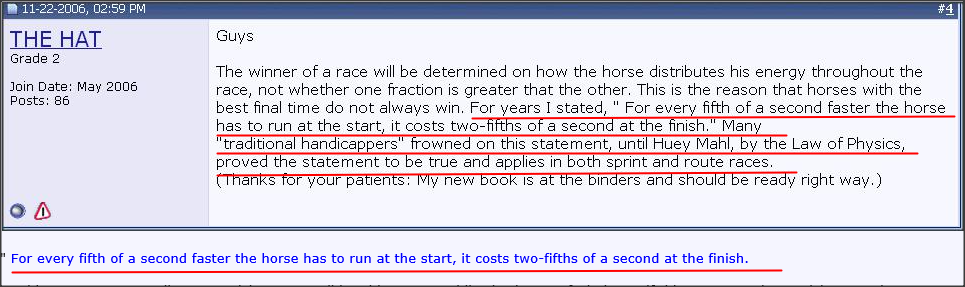
Huey Mahl used Physics to prove that for every fifth of a second of “energy expenditure” spent on the early pace will affect the finish by two-fifths. Huey Mahl accentuated and proved what Jim Bradshaw had been telling us for years. Mahl also stated that:
The early pace has a “telescopic effect” on the rest of the race.
It can be interpreted that the early pace has an
“exponential effect” on the rest of the race. Therefore, according to Huey Mahl’s hypothesis; any linear math expression used to determine speed figures are incorrect or “not optimal.” In order to express an optimal speed figure equation, it must have account for the early pace “exponentially”. In other words, any linear “speed figure” formula that uses 1st fraction + 2nd Fraction + 3rd Fraction adjusted by a variant or [ (1st fraction) + (2nd fraction) ] or early pace + late pace equals Final Time adjusted by a variant is flawed.
The Paceline
1st Fraction + 2nd Fraction + 3rd Fraction = Final Time
We are aware of the above equation in measuring a paceline in the past performances of thoroughbreds. The final time is the sum of three fractions.
Knowing this equation; we can write:
We let F = Fractional time and being aware that the value of (1st F + 2nd F + 3rd F ) = Final Time or using the math principle of “substitution property of equality” we have:
1st F + 2nd F + 3rd F = [1st F + 2nd F + 3rd F ]
We move the 3rd F value across the other side of the equal sign; therefore we have:
1st F + 2nd F = [1st F + 2nd F + 3rd F ] -3rd F or
1st F + 2nd F = Final Time - 3rd F
Essentially, the sum of the early pace fractions is equal to the Final Time minus the 3rd Fraction. This is simple enough to comprehend.
Now we will focus on energy changes in the early pace and its effect on subsequent fractions and its effect on the final time as a consequence of changes of energy expenditure. We can express the changes of “fractional times” by using the above equation with changes of units of energy by this equation:
1st F(X) + 2nd F(Y) + 3rd F (-1)(X +Y) = Final Time
We let X equal the value of changes in the 1st Fractional time;
We let Y equal the value of changes in the 2nd Fractional time and/or 2nd call pace time
Now using this equation we now want X and Y to stand for the unit change in “fractional times” or unit change in energy; where energy will be express in changes in ticks of energy changes. In horse racing parlance,
a tick of energy is a (fifth) of a second.
We inserted the factor (-1) to the 3rd Fraction to multiply the net changes of (X+Y)
to adhere to the “law of conservation of energy” and to balance this energy equation to show that changes in energy will be accounted for in this equation and to show that energy is not created nor destroyed. So the number (-1) or negative 1 is very important for this equation and for us to adhere to the “law of conservation of energy.”
We acknowledge that horses are not machines but animals of flesh and muscles so we insert “limits of changes” like a “calculus equation” and acknowledge that any extreme exertion of energy can result in “
energy dissipation” or “Entropy.”
In 2nd F(Y), we account for changes in fractional time as in the second turn time and/or second call pace time. In linear math, this will not make sense; but in Physics, it makes perfect sense as changes in time requires energy which is similar to going from 3G forces to 4G forces. It takes so much more energy to run the 4Furlong fractions under 44.0 in sprints or under 1:10 6Furlong fractions in route races.
Another example might be stepping on the car’s accelerator in the first mile to accelerate from 50mph to 60mph which will use up energy or work; then using the brakes to slow down the speedometer in the 2nd mile from 60mph to 50 mph. By using the brakes, we are slowing down the “momentum” of the moving car which expends energy and/or work. Momentum is extremely important in Physics because it is a quantity that is conserved in every closed system: that is, unless you put in or take out energy from a system, then the the sum of the momenta (plural of momentum) before an event will be the same as the sum of the momenta of all the parts after the event This energy expenditure in acceleration or deceleration must be accounted for in Physics.
Since we know that:
1st F + 2nd F = Final Time - 3rd F
In the following energy expression equation:
1st F(X) + 2nd F(Y) + 3rd F (-1)(X +Y) = Final Time
We move the 3rd Fraction property across the equal sign and to adhere to the “law of conservation of energy”, we have:
1st F(X) + 2nd F(Y) = Final Time – [ 3rd F (-1)(X +Y) ]
By focusing on energy changes exclusively; we have
(X)change in 1st F + (Y)changes in 2ndF = Final Time minus [ (-1)(X+Y) ]
We now let X = change in unit of energy>> faster or slower or ( +/- ) in the first fraction time and;
We now let Y = change in unit of energy>> faster or slower or ( +/- ) in the 2nd fractional time and/or 2nd call pace time.
Now it should be noted that if a horse changes a first fractional time and maintains his previous 2nd Fractional turn time, this changes the original 2nd call fractional time which will affect an energy change. More examples of this statement later….
Therefore we now have a formula to express the effects of changes in energy in the early pace of the race on the Final Time that follows the “laws of Physics” by using the “law of conservation of energy”.
We do not know how Huey Mahl proved Bradshaw’s statement exactly but we can follow the “law of Physics” by using the “law of conservation of energy” to retrace Huey Mahl’s thinking and to express Jim Bradshaw’s statement. It is given that we are dealing with horses who are animals; not mechanical machines- but energy expenditures and energy dissipation or “entropy” can be expressed mildly.