As Ted wisely alluded to the other day, the contender/paceline selection is merely a starting point to the handicapping process. While we may narrow our contention down to the horses who are the likeliest to win, it is easy to forget/overlook that the horses whose chances of winning are low % (our non-contenders) are still running in the race. A non-contender can impact the running of a race in many different ways, most notably in the early running.
Based on my contender mix, #'s 5 and 8 are Early/Early presser types. If the race only consisted of the 4 contenders in my mix, the early pace analysis would be cut and dry, as #8 has an F1 advantage over that rival. But it's not that simple. The reality is that there are 7 other horses entered (pre-scratch), which means that others may impact the pace. Judging by #3's recent form cycle, I don't see that one impacting the early running, although it did chase a strong pace in a compact field two starts back. However, #7 (20-1 ML) is an early energy runner and tends to be forwardly placed. Looking at its PoH velocity and E/L differential graph, it is capable of throwing down aggressive early fractions and burning up energy:


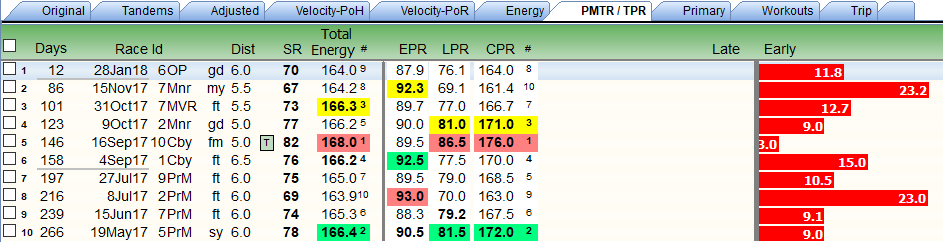
The presence of the #7 horse figures to have an impact on the early pace scenario as both #5 and #8 will either have to outrun #7 to gain the front end, or keep up with #7's potential pace so that one doesn't get an uncontested lead. Likewise, if either #5 and/or #8 outrun the #7, all those runners figure to burn extra reserves to keep to task. Either way, this spells bad news for those horses, as they will have to use a greater amount of energy. This is reflected in the %Med:

Barring scratches and/or an out of the blue change in race dynamics, this race does not favor the early matchup.