Quote:
Originally Posted by Bill P

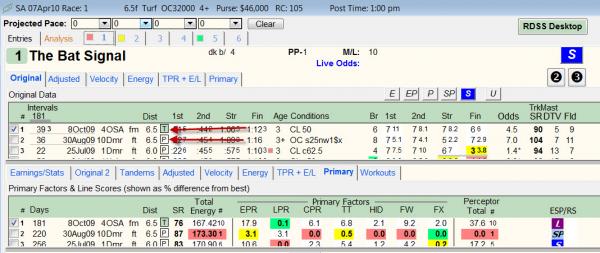
I chose the last race because, well it was the most recent, the same distance, and the same surface. However, Preceptor suggests PL2 which is 6.5 Poly. As you can imagine, it makes a big difference. With PL1 the horse is the Tier 4 horse, with PL2 it jumps to Tier 1. Unfortunately, the horse was scratched so I'll never know which line was most appropriate.
Any thoughts on this?
Bill
 |
Before I answer YOUR question, I have a question for you.
If this horse had NOT been scratched, and if you had used line 2, and if this horse had run “up the track”, what would YOU have thought looking back at YOUR line selection for this horse or even YOUR decision to include the horse at all?
I ask you this question in this way, since “failure” is the only reason for re-consideration of what you have done. There is nothing worse than an “early success” that will ultimately lead you down the path of ruin because you are not aware that you are doing anything wrong.
Now my answer to your question.
( c ) none of the above
1 – I would not use any horse that hasn’t run in the last 90 days (94% of all races at all tracks all over the U.S. and Canada are won by horses that have raced in the last 90 days year in and year out.)
2 – had the two races in question been within the last 90 days, I would choose NOT to use this horse. It was beat by 5 horses in its’ last race and 6 horses in the 2nd race back and was NOT “in the hunt” in either race
3 – turf lines should always be used in favor of any other surface. Turf is turf and anything else is "other than turf". If the horse does not have a turf line, eliminate the horse.
4 – if the field of horses you are currently working with do not have many turf lines, you always have the option to PASS THE RACE or.......... throw darts while being blindfolded
5 – if you look across each line there is a column labeled “SR” (speed rating), you will notice that line 1 indicates an SR of 90, while line 2 has a SR of 104. THAT is the reason for the horse showing much better using line 2 than line 1
6 – computer programs “crunch numbers” that’s all. It is up to YOU to make decisions about the numbers you ask the computer program to analyze.
7 – better decisions by YOU equals better results
Good Luck!