 11-08-2011, 09:51 AM |
#5
|
|
Grade 1
Join Date: Jun 2005
Location: Nanaimo, British Columbia, Canada
Posts: 9,264
|
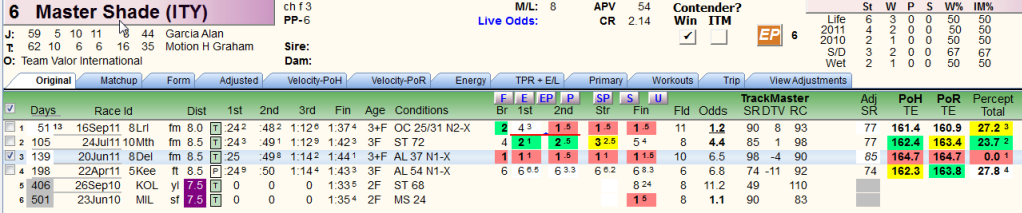
I always first consider the strongest lines within the last 3 or so (excepting non-comparable ones, e.g. surface, distance, bad trouble, etc). I use the Perceptor Total as an initial guide for this (others use Adjusted SR, or Total Energy). You decide on an absolute cutoff date for a representative paceline: e.g. 90 days, 180, 280, but I tend to keep it within 9 months max, but the earlier the better.
THEN, I try to find reasons not to use that best line for a horse (i.e. too high rating, won't be repeated, etc). If it appeared that this horse hadn't done ANYTHING since its 3rd line back, it would be a different story: there would be real questions as to current fitness and ability to duplicate that earlier effort, despite the layoff and 3 (middling) works in 27 days.
But its win 51 days ago tells that (at least then) it was fit enough to set or overcome the pace it needed to. Importantly, we need to decide if we know why the ratings declined since the 3rd line back. Sometimes we don't know; sometimes the horse was clearly going off form. Consider the Pace of Race Total Energy - PoR (2nd right-hand column for the horse). This horse likes to run earlier, but it either chased or set a slower PoR in each of its last 3 races because that's as fast as it needed to run to be in its preferred position. Consider the axiom that 'a horse runs as fast as it needs to, not as fast as it can'.
SO - it ran as fast as it needed to, and the declining Total Energy and Perceptor rankings don't necessarily reflect a tailing off of form. Perhaps it was tailing off - it got a 60 day rest - and perhaps the connections were seeking a good placement for the next outing (or simply waiting for Aqueduct to open).
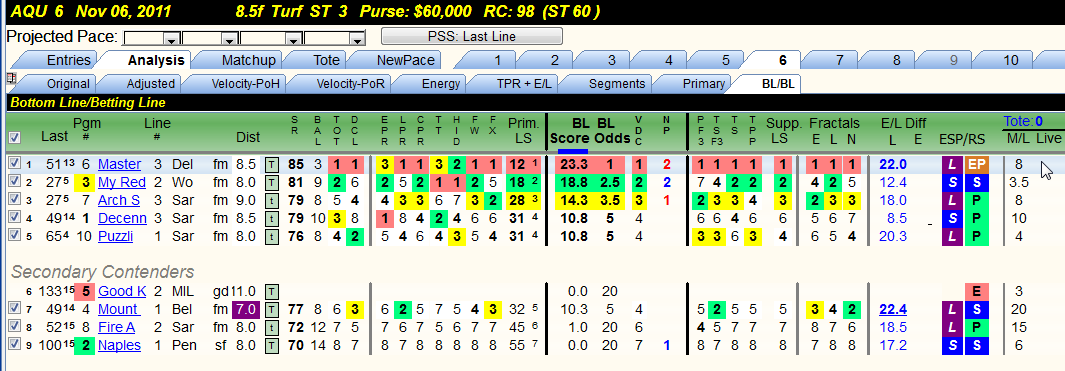
All of this is debatable subsidiary analysis attempting to answer the question: should I use the best line for this horse. I always attempt to take a more conservative route when thinking how to represent a horse today from its past performance. If we use the 3rd line, note how it ranks on the BL/BL screen - the best by nearly 5 rating points over the next horse, the #3 - that is a lot of BL points! So, a conservative approach would be to ask: how many points less, or how much worse a performance than the 3rd line back would still make this horse a bettable contender today. If the rank positions of the #6 and the #3 (the 1st and 2nd ranked) were reversed, and the odds were still 10-1, the #6 would still be a bet, so we can allow a seriously worse performance today than that 3rd line shows and still bet on the horse at 10-1.
That is some of the thought process I go through when rationalizing using an older paceline. Apply these criterea for every horse though. BJennet's point is well made (and before Massa or Schwartz, Sartin was making the same point) - recency is more or less well priced. The more cautious bettor will receive the more cautious price. You will lose a few of these, because (as John from Cincinnati says) 'some things we know and some things we don't know. But this kind of horse is precisely what the modern Sartin Methodology (i.e. late 1990's +) was designed to identify.
Ted
__________________
RDSS - Racing Decision Support System™
Last edited by Ted Craven; 11-09-2011 at 05:28 PM.
Reason: font size, image size
|

|

|