Just to be clear - all this analysis has the benefit of hindsight! I'm not making the case that I 'called'
anything correctly - only pointing out things I observe from some experience, which are possible to see during pre-race analysis. Observations which I think carry over to many, many future races.
Speaking of zeroing in (in this race) on which of the Earlies might survive (or none of them) - let's stipulate that the
#1A is too slow and will not win, and so focus on the fate of the
#9 which I said will be taken down by the early fight. (And set aside for the moment that with the #1A out of the Win pool at a little over 2-1 or a little less than 33% of the pool - you could dutch ALL the rest of the horses and make money ...). Let us then demote the #1A from Primary contention but leave the #9 in for the moment.
Since I used the #9's last line (or 2nd line) as a
projected pace against which the #1A will fight, what are the credentials of the #9 to hang on? How would we measure that?
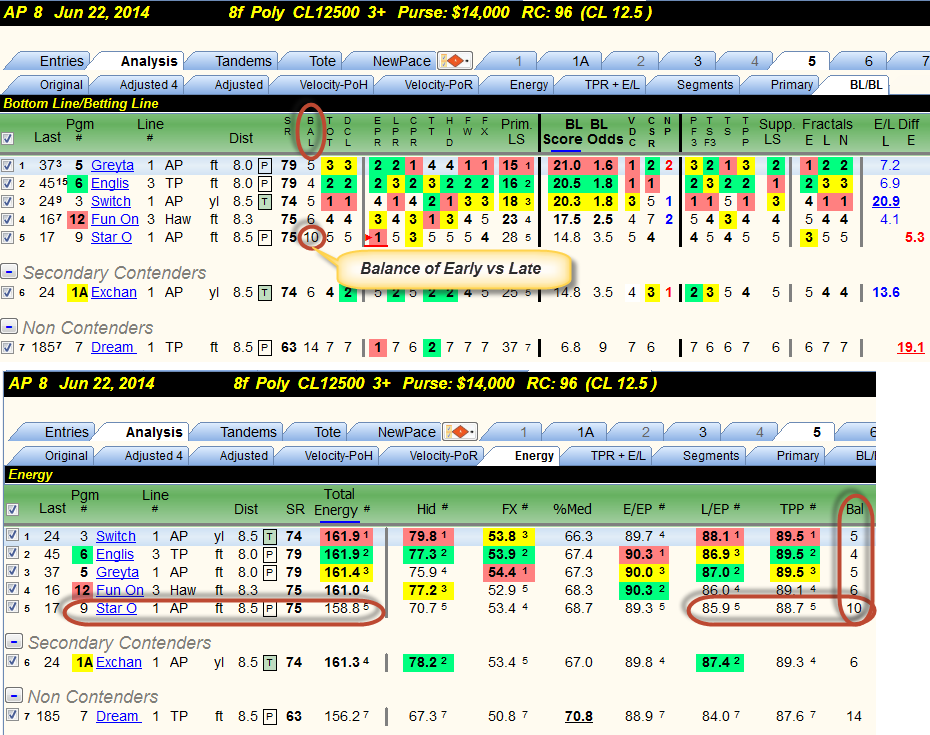
For those who don't know, the
Balance number on BL/BL is the sum of the E/Ep (Early Energy Potential) and the L/Ep (Late Energy Potential) from the Energy screen (2nd image above). It is intended to show the '
balance' between Early and Late energy. With 5 horses in the Primary section of BL/BL - the
worst balance you can have is 10 (5th + 5th). Dr Sartin had long written that
horses with a Balance greater than 8 are poor candidates to Win - either because they are ALL Early and NO Late, or simply TOO Late. The reason for this, for the #9, is simply because - relative to the rest of the horses we have called Contenders - it has the lowest Total Energy (and E/ep and L/ep is another slicing and dicing of Total Energy).
Look at a collection of the last 5 races of the #9 (and there's really no reason to use a 5th line back, or a 4th, to measure this horse when we can see it is relatively fit, given its inherent ability):

It is almost the inverse of the #12's past lines. It has
all Early energy,
but very little Late. If it was not being challenged by the #1A and (pre-race) possibly by the #5 (who ended up the actual challenger to the #1A) - in other words a LONE EARLY, then it might be a candidate to steal the race. But not today. A tangential observation to this is that it has accomplished its recent good results in much lower calibre races and now steps UP against other horses who are indeed stepping DOWN (all of which is corroborated by its relatively low Total Energy numbers).
So - is there a weakness to the #9? Is it possible it will outlast BOTH the #1A AND the #5? Perhaps, and our entire game deals with things we cannot know, yet must make decisions about based on '
seen this kinda thing before ...'. The #9 is typical of a horse who does not have a sufficient
Balance of Early and Late energy. That's one way I know to judge whether an Early horse may dominate in a speed duel.
It is interesting that this observation about
Balance of Early/Late touches on the article written elsewhere here by
Tim Y on Order within Chaos, specifically the part about universal complimentarity or yin/yang. Within every predominantly Early horse is a relative measure of Late energy distribution, and within every Late horse is a certain measure of Early (the yin within the yang within the yin). Everything about analysing the horses on our readouts is measuring
relative - not absolute performance. A slow Early horse wins a one-horse race! How little Late energy is an Early horse allowed to have (relative to the rest) before it needs to call on that Late energy and find it insufficient? How close to the early pace does a Late energy horse need to stay before its too far back to capitalize on a collapsing group of Earlies. That is an example of
relativity, as Tim Y might put it . And often this relative Balance is not knowable enough to make a clear decision, which sometimes causes us to pass the race. OR - use such 'random' horses with equivocal Early/Late characteristics in vertical betting positions which compliment the positions where other horses' abilities are more clear. (If that's clear ...).
Anyway, that's something I see about the #9, and why it is not the prime candidate Early to prevail over its other Early competition. You can apply this analysis on many races and some of those scenarios will work out and some not. Regardless, it's still worth observing.
Ted